Today • Islamic Date -

Next Prayer: London -

Recent Donations -

Muslim Aid Media Centre

Three years into the Gaza conflict, Anisah Khan, Content and Copywriting Officer, explores the mental health crisis, the impact of trauma on families and the role of faith in enduring hardship.

Hasbunallah: Faith, Trauma and Survival in Gaza

This month marks three years since the violence in Gaza erupted to unimaginable levels. It also marks World Mental Health Month; as such, it is important to acknowledge the harmful and irreparable damage that the violence has inflicted upon the psyche of Palestinians.

Through it all, one phrase has been repeated most often in Gaza, a prayer: Hasbunallahu wa ni’mal wakeel, that Allah is sufficient for us, and He is the best disposer of affairs.

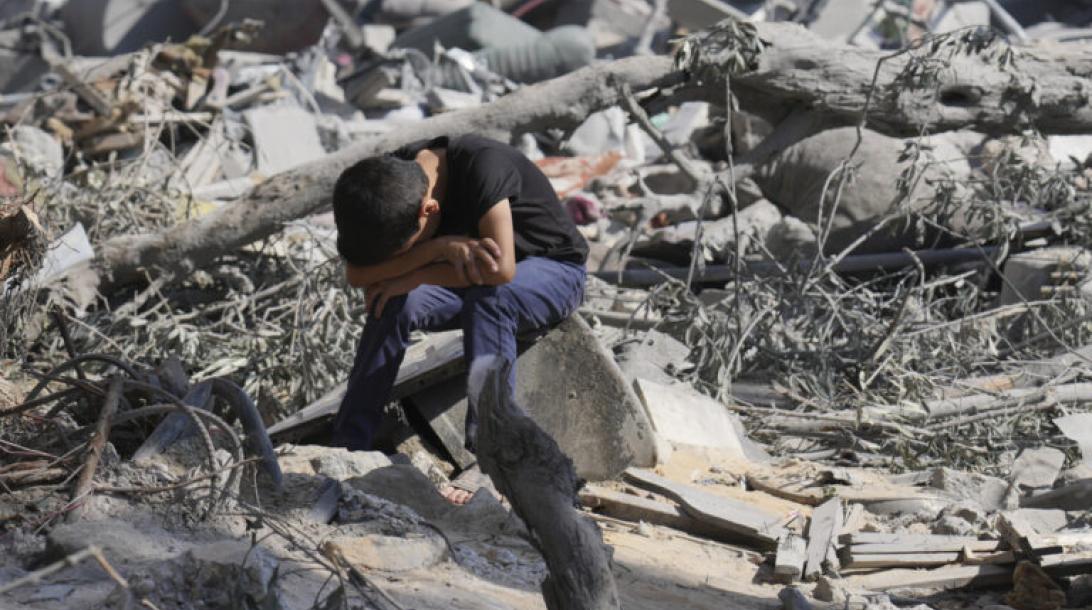
We have heard it from fathers digging through rubble, from mothers holding children wrapped in white shrouds, from boys standing outside hospitals with nowhere left to go.

Three years on, we explore what this war has done to the minds and hearts of Palestinians in Gaza and what Islam teaches about extreme struggle and pain. The reality in Gaza is that war and the trauma that come with it is generational - this did not begin in October 2023. Families in Gaza have struggled with dispossession since 1948, occupation since 1967 and a blockade since 2007. Many of the children traumatised are the children and grandchildren of Palestinians who were traumatised before them.

The wound you cannot sew

The physical destruction of Gaza can be photographed, but psychological destruction mostly cannot.

A year into the war, researchers surveyed 405 adults in Gaza. The results, published in Conflict and Health, were stark:

Condition Adults Affected
Probable PTSD  83.5% 
Moderate to severe depression  73% 
Moderate to severe anxiety 

65% 

All three at once 

54% 

The strongest risk factors were losing family members and witnessing violence. In Gaza, this factor does not discriminate.

For children, the picture is worse. UNICEF reported in December 2025 that around 1.1 million children need psychological support, which is nearly every child in the Strip. Fewer than half had received any.

The word “post” in post-traumatic stress assumes the danger has passed. For people in Gaza, it has not. More than 1,300 people have been killed since the ceasefire began. Most families have been displaced multiple times over, and they are facing a fourth winter in tents. Trauma here is not a memory to process; it is a constant and evolving experience.

Hasbunallahu wa ni’mal wakeel

Across three years of footage from Gaza, one phrase is consistently spoken.

Hasbunallah means “Allah is enough for us.” Wa ni’mal wakeel means, “and He is the best One to entrust our affairs to.” It declares that Allah’s support is sufficient through every experience.

The phrase is in the Qur’an, in Surah Al-Imran (3:173). After the Battle of Uhud, the believers were wounded and grieving. They were told a great army had gathered against them and that they should be afraid. Instead, their faith grew, and they answered: Hasbunallahu wa ni’mal wakeel. The next verse says they returned with Allah’s favour, untouched by harm.

Ibn Abbas reported, in Sahih al-Bukhari, that Prophet Ibrahim (AS) said these words as he was thrown into the fire, and that Prophet Muhammad ﷺ said them when told the enemy had gathered against him. It is the language of people who have run out of earthly options.

When a grieving father says hasbunallah, he is not saying he feels no pain. He is saying his pain has somewhere to go. He is also making a complaint against those who wronged him and handing it to the One who judges. It is surrender and protest at the same time: I cannot get justice here, so I take my case to Allah.

These clips have moved Muslims and non-Muslims around the world. People expected rage or despair. What they saw instead was a person with faith tested to their limit and still standing resilient.

Faith does not mean feeling no pain

There is a harmful idea that a person with strong iman should not struggle with grief, fear or trauma. The Qur’an and the Sunnah teach the opposite.

When Prophet Ya’qub (AS) lost Yusuf, he wept until his eyes turned white with sorrow (12:84). His answer was not to hide it but to direct it:

 I only complain of my grief and sorrow to Allah (12:86).

When the Prophet ﷺ held his dying son Ibrahim, his eyes filled with tears. He said the eyes shed tears, and the heart grieves, but we say only what pleases our Lord (Bukhari). Tears were not a failure of faith. They were part of it.

Patience in Islam is holding on to Allah while the pain is real, and not letting hardship turn into despair or turning away from Him.

Allah says He will test people with fear, hunger and loss of wealth, lives and crops, and He gives glad tidings to those who, when struck by calamity, say inna lillahi wa inna ilayhi raji’un, that we belong to Allah and to Him we return (2:155–156). He also promises, twice, that with hardship comes ease (94:5–6), and that no soul is burdened beyond what it can bear (2:286).

The Prophet ﷺ said the believer’s affair is wonderful: when good comes, they are grateful, and it is good for them; when harm comes, they are patient, and it is good for them (Muslim). Every experience, therefore, holds meaning and reward to be reaped in the next life.

It is imperative to note that accepting Allah’s decree does not mean accepting injustice. The Qur’an warns:

Do not think Allah is unaware of what the wrongdoers do (14:42). 

Justice will be served either in this life or in the next, for Allah is Al-‘Adl, the most just.

For anyone reading this who is struggling with what they have watched from afar: grief, anxiety and helplessness are human. Taking them to Allah, and to people who can help, is a strength.

Faith and care, side by side

Islam has never pitted faith against practical help. The Prophet ﷺ said that Allah sends no disease without also sending a cure (Bukhari). Seeking treatment, for the body or the mind, is part of trusting Allah. Tie your camel, then rely on Allah.

That is the thinking behind Muslim Aid’s health work in Deir al-Balah. Our mobile medical unit combines primary care with mental health and psychosocial support (MHPSS), so families can be treated for physical illness and for trauma in the same tent.

Phase  What was delivered 
Phase 1 (2025) 6,618 people supported; 3,201 pregnant women and children given maternal and child health care 
Phase 2 (2026)  9,238 people reached; maternal and child health services up almost 300% 

Healing in Gaza will take a generation. It will also need trained counsellors, safe spaces for children and an end to the violence that keeps reopening wounds. It will also draw, as it always has, on the faith that holds people together.

What we can do

The people of Gaza have said hasbunallah - Allah is enough for them. The question is whether we will be among the means He sends.

  1. Make du’a. Pray for the people of Gaza by name in your prayers: for the grieving, the injured, the orphaned and the frightened.
  2. Give. Your donation funds medical care, mental health support, food and winter shelter. Donate here.
  3. Keep speaking. Share what is happening. Silence is what lets suffering continue unseen.
  4. Look after yourself. If watching this has left you anxious or low, talk to someone. Turning to Allah and to people who can help are both acts of faith.

For interviews, please contact Rand Odeh, UK Communications Officer, at [email protected] or [email protected]

Interview opportunities available with spokespeople from Muslim Aid.

Visual assets available.

We are a faith-based British international charity that provides help to people who are victims of natural disasters or conflict or suffering from poverty, hunger, disease, homelessness, injustice, deprivation or lack of skills and economic opportunities.

020 7377 4200 | 020 7870 1602