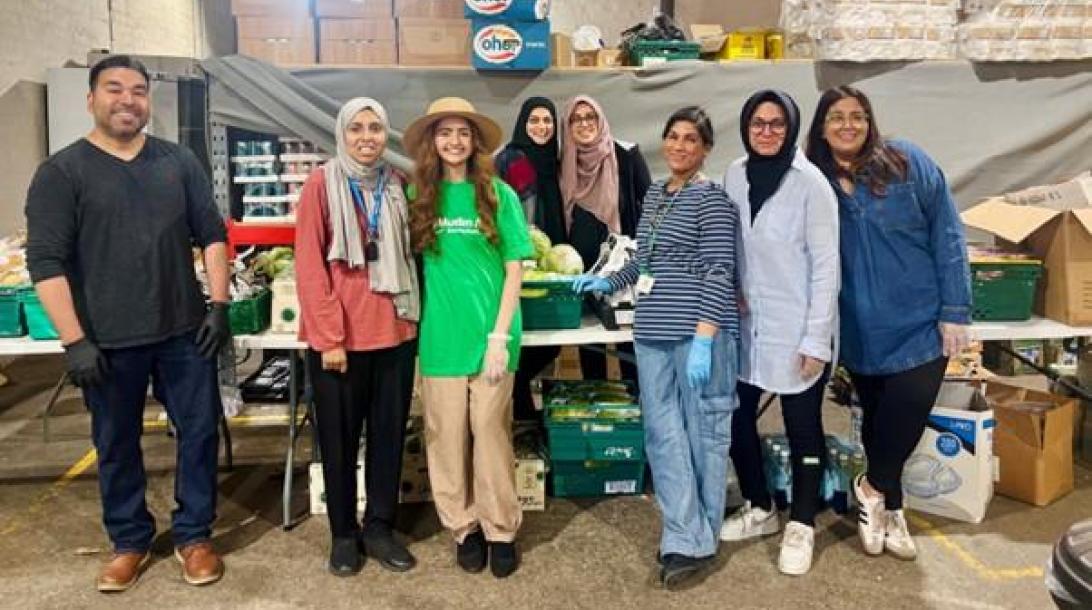

In the quiet streets of Birmingham, tucked away in the heart of the community, a small yet powerful initiative is rewriting the narrative of how aid is delivered in the West Midlands. Clifton Road Food Bank (CRFB) isn’t a grand, global organization, nor does it operate from glass offices with branding budgets. Instead, it thrives on the spirit of everyday people, which includes volunteers from different walks of life who’ve come together, not to give charity in the traditional sense, but to build dignity, community, and hope.
CRFB was founded by Shabir Jivraj and a group of friends and family, inspired by a decade-long journey that began with handing out food to displaced people in Birmingham’s city centre during Ramadan. But it was one cold, wet October night that sparked a thought: “There must be a better way.” That spark turned into action, and in July 2018, opened CRFB its doors to the local community, rooted in a powerful ethos: dignity and choice.
Unlike traditional models where aid recipients are often passive ‘rights holders’, CRFB calls its users “members.” Members are not just handed out pre-packed boxes, they walk through the space, select groceries and toiletries based on their family size, and leave the CRFB premises with not just a bag of groceries but with respect and a stronger sense agency. A single person might receive £10 worth of support, a couple £15, and a family £20. Fresh fruits, vegetables and bread are always on hand, and crucially, so is autonomy. Since its establishment in 2018 CRFB has distributed over 54,673 care packs to 229,626 people.
‘I am not going to lie the food bank is helping me a lot! even though I work I don’t get shifts for multiple months and I have 5 kids and 10 cats (laughs), with a large family size I am in debt, even if I get money from the universal credit it is not enough… all my kids have special diets and choices and the food bank helps a lot with that.. with the other food banks the processes are long, limiting and difficult, the quality isn’t very good either because the food expires early, so I am very happy to be a member here’
(Grace)
But CRFB has grown to be much more than a food bank. It has evolved into a community hub, where people feel not only welcomed but heard and supported. Community members often turn to the CRFB team for advice, referrals, or simply someone to talk to. Those struggling are signposted to other local services, creating a web of accessibility and shared knowledge. This environment of trust and connection means that support doesn’t end at the shelf - it continues into mental health services, housing advice, or employment support etc. Through this, CRFB isn’t just responding to need, it is in fact helping people navigate it.
Over time, CRFB has also become a place where interpersonal trust is built and nurtured. Members, many of whom are women with children, single parents, people with disabilities, and individuals often isolated from public support systems, find not only food but a safe and supportive space. Women, in particular, bring their children because they feel secure within the environment - an environment that is predominantly led by women volunteers, reflecting the communities it serves and reinforcing comfort and care. That sense of trust has also enabled CRFB to become a connector between people and services. It’s not just about giving aid - it’s about sharing information, building a support system, and helping people make sense of the help available around them.That’s a profound form of accessibility, and it’s what makes CFB more than a service point, it’s a lifeline.
This summer, as part of Muslim Aid UK Programmes 2025 Qurbani distribution, CFB once again demonstrated how deeply community-rooted aid transforms the experience of giving and receiving. The meat was distributed with thoughtfulness and fairness - but beyond that, something deeper occurred. Members - many of them women with children, people with disabilities, and individuals often excluded from mainstream services - felt seen, valued, and included. It wasn’t just about the distribution. It was about the relationships. Volunteers knew their names, not just their registration numbers. These moments remind us that aid isn’t just about sustenance, it’s about solidarity. In many ways, CRFB has become a quiet but vital support network for some of the most marginalised in the area.
What sets CRFB apart isn’t just what it gives, but how it gives. It disrupts and challenges the idea of viewing aid recipients with pity, or as desperate and destitute. Here, many members are also volunteers - working alongside others, contributing time, building community, and reclaiming their agency.
‘I have been a volunteer and member for years now and I feel very happy about it, the people who come through the food bank are also really happy, there is good food and no trouble, the service is really good and that is why you can see the number of people has increased, over 100 people come to the distributions now! As a service user myself, I have 11 family members, when I return home with eggs and crisps (along with other items) my children are very happy’.
(Mubarik)
In this space, aid is not a transaction; to the ‘poor’ it is in fact it’s a safe and trusted relationship. A relationship that is simply based on the provision of support to people who need it.
This kind of local initiative is at the heart of a changing aid landscape - and Muslim Aid UK is actively driving that change. Traditionally, large international NGOs were the primary engines of humanitarian response. But now that the model is shifting. Rather than delivering aid through top-down structures which facilitate colonial power structures, Muslim Aid is embracing and championing localisation through its partnerships in the UK, with the idea that those closest to the problem are the best placed to respond.
Muslim Aid’s funding to grassroots initiatives like CRFB is not just a financial contribution - it’s a spark. A small act that triggers a series of community-driven actions. This is the butterfly effect of compassion: where a single wingbeat, one grant, one bit of support, enables a cascade of change at the local level.Like ripples spreading outward in still water, the impact of that support extends far beyond its starting point reaching individuals, families, and entire communities. The aid no longer flows only from donor to recipient; it cycles through community, building resilience, dignity, and shared ownership.
In doing so, Muslim Aid steps back from self-implementation, choosing instead to support local actors, in the best capacity, who understand their communities intimately. CFB isn’t just feeding people, it’s redefining aid and Muslim Aid is proud to support them in it. Community organisations like CRFB shows that support does not necessarily comes from polished campaigns and glossy reports, but from community members who know your name, who ask what you need rather than assume it.
In a time when the world is increasingly fractured, and economic precarity is hitting more families than ever in the UK, the rise of community-based models is both a necessity and a powerful testament to collective care. Charity is no longer the sole domain of large, well-known NGOs. It is being reclaimed by communities, who are not waiting for solutions but in fact they’re building them.
The work of Clifton Road Food Bank is a reminder that dignity is not an add-on to aid but in fact is the foundation of it. And the role of organisations - including Muslim Aid - is not to overshadow that work, but to uplift it, quietly and effectively.
In the flapping wings of a butterfly in Birmingham, lives are being nourished, stories are being rewritten, and hope is taking root.
We are a faith-based British international charity that provides help to people who are victims of natural disasters or conflict or suffering from poverty, hunger, disease, homelessness, injustice, deprivation or lack of skills and economic opportunities.
© Copyright 2026. Muslim Aid - Help Muslims Around the World in Need . All Rights Reserved.
Charity CIO No. 1176462
Serving humanity since 1985.