Today • Islamic Date -

Next Prayer: London -

Recent Donations -

Muslim Aid Media Centre

Gaza update: How does Muslim Aid continue to deliver aid?

Disclaimer 

The situation in Gaza is highly dynamic and fluid. Our programming adapts daily to changing restrictions, emerging access limitations, and security risks. All activities described here reflect operations as of September 2025 and are subject to change. 

What aid is Muslim Aid currently providing in Gaza? 

Muslim Aid is delivering shelter, food, and psychosocial support to displaced families. A very small number of individuals also receive livelihoods support. Winter assistance, focused on shelter and non-food items, will begin in November 2025.  

Who are the target groups for this aid? 

Aid targets all families displaced from their homes, with priority for the most vulnerable, including women, children, people with disabilities, and those forced to flee under threat. While priority is given to the most vulnerable, all displaced individuals face dire needs after losing their homes and possessions. 

How is food being provided, and how has inflation impacted food provision? 

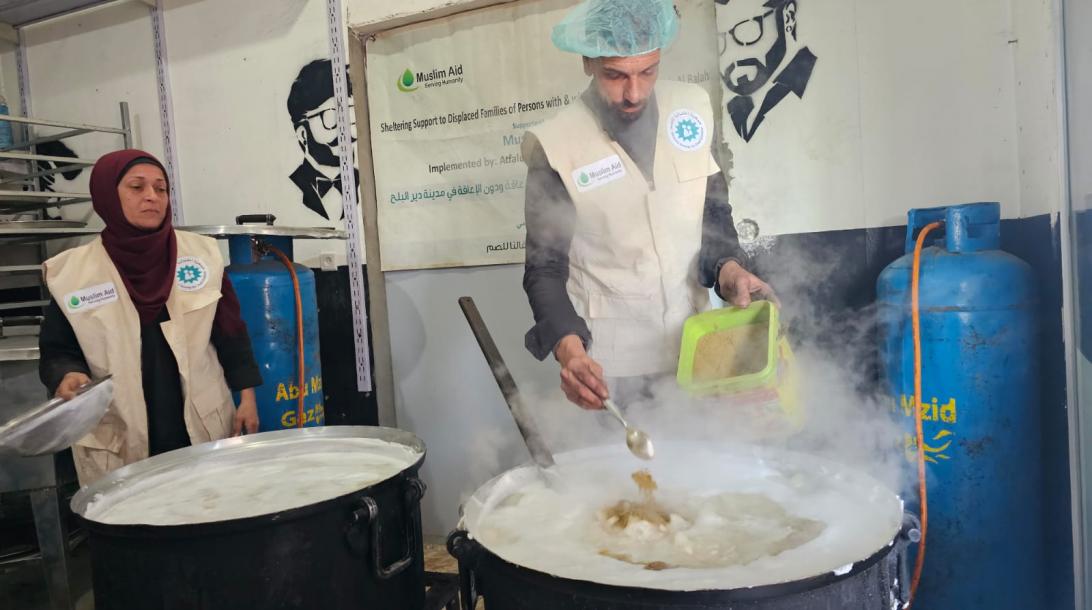
Food is locally procured from trusted vendors in central Gaza. Each family currently receives two hot meals per day, including vegetable stews (like zucchini and eggplant) and dry meals such as lentils. 

Inflation and supply constraints have dramatically reduced purchasing power. Before the escalation, $15 could cover a modest family food basket. By July, a single hot meal was priced at approximately $60 per family per day, making food provision one of the most pressing operational challenges for partners on the ground. 

What is the main challenge for aid delivery in Gaza? 

The primary challenge is restricted access combined with inflated prices and damaged infrastructure. Israeli-controlled border permits severely limit the quantity and type of goods entering Gaza, while local markets have high prices and limited supplies. Partners also face electricity shortages, fuel scarcity, disrupted communications, and security risks, all of which make aid delivery unpredictable and expensive. 

This combination of access restrictions and cost inflation is the key operational constraint affecting all humanitarian work in Gaza. 

How does Muslim Aid deliver aid despite these restrictions? 

When possible, Muslim Aid is able to deliver aid to Gaza through Israeli-controlled borders, where permits are required. Limited supplies are transported via coordinated humanitarian convoys. When border access is restricted, we rely on pre-stocked inventories and local procurement from suppliers and farmers. 

All programming is implemented through long-term local partners who oversee aid distribution, this includes managing contracts with suppliers for local procurement and trucking to distribution sites, as well as coordination with other humanitarian actors for beneficiary and site selection. Working with local staff is crucial, as they have the deepest understanding of the communities, needs, and locations, allowing aid to reach those who need it most even when access is severely limited. 

Where are displaced populations currently located? 

Since Israel's invasion of Gaza City on September 16, 2025, most displaced populations have sought refuge in Khan Younis (Al-Mawasi area) and central Gaza. Some remain in Gaza City (north), under severe attacks aimed at forcing them south.  

What are the main challenges and risks in delivering aid? 

Delivering aid in Gaza remains extremely challenging due to: 

  • Poor internet connectivity 
  • Limited transportation due to fuel scarcity 
  • Electricity outages and blackouts 
  • Liquidity shortages and money transfer restrictions 
  • An unsafe environment where everything and everyone is at risk 
  • Administrative barriers such as delays in project approvals and movement permits 

These challenges, combined with soaring costs and limited access, require constant adaptation and collaboration with field partners. 

Why have operational costs risen so much? 

The World Bank (February 2025) reports that around 80% of Gaza’s power generation and distribution assets have been destroyed. Frequent power outages disrupt healthcare, water treatment, food production, and sanitation. Humanitarian actors must rely on costly emergency repairs and alternative energy sources. Operating expenses for temporary energy solutions have increased by up to 700% in some areas, while fuel scarcity, high inflation, and logistical challenges continue to drive up costs for aid delivery. 

Where is Muslim Aid currently operating in Gaza? 

Deir Al Balah: 

  • Inclusive shelter and nutrition support for displaced families, including people with disabilities 
  • Daily meal distributions and psychosocial support assistance 
  • Winter assistance (shelter/non-food Item support) scheduled for November 2025 

How does Muslim Aid ensure continuity of aid? 

Muslim Aid works with long-term local implementing partners who manage contracts with suppliers and farmers to access critical supplies urgently needed by displaced communitiesThis model ensures continuity, builds local capacity, and allows us to adapt quickly to changing conditions. 

Reference: World Bank. (February 2025). Gaza and West Bank Interim Rapid Damage and Needs Assessment, Sections 100–102. 


We are a faith-based British international charity that provides help to people who are victims of natural disasters or conflict or suffering from poverty, hunger, disease, homelessness, injustice, deprivation or lack of skills and economic opportunities.

020 7377 4200 | 020 7870 1602